
Tucker Carlson Is Already Running for President
The conservative media icon is positioning himself beyond Trump

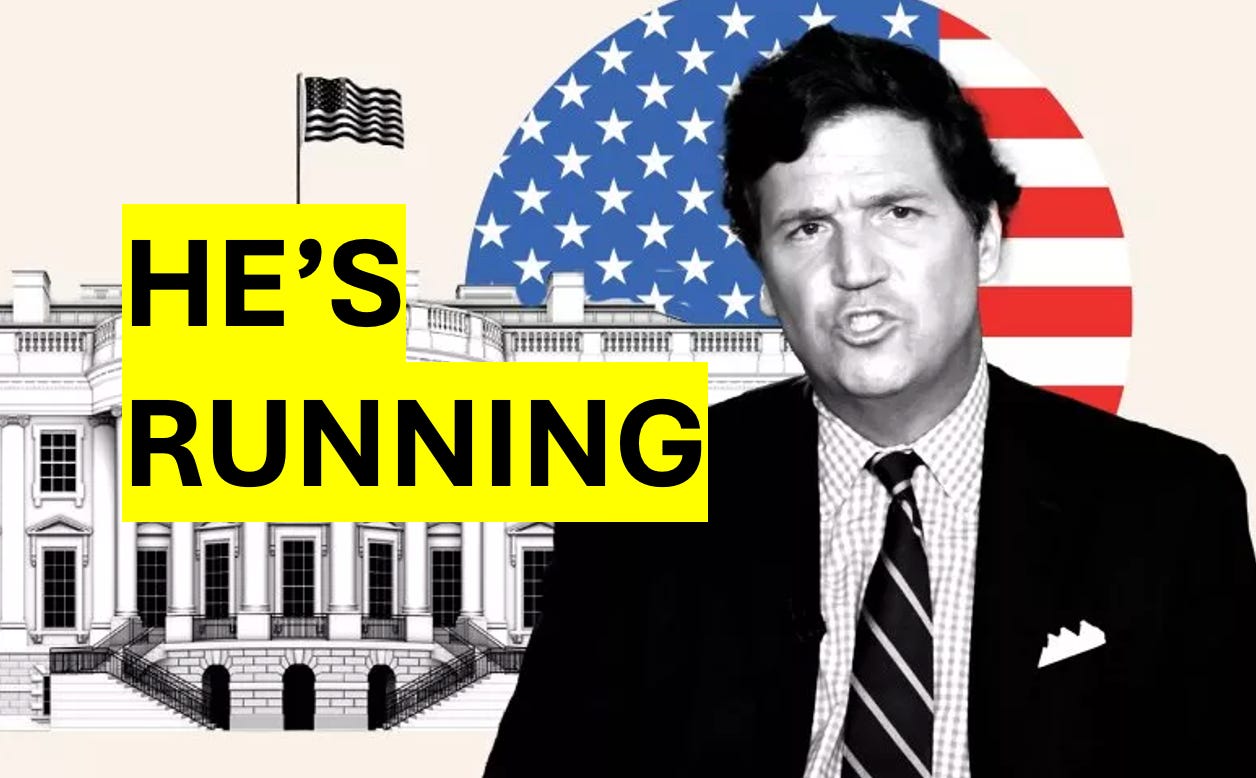
Tucker Carlson may not have filed any paperwork. He hasn’t stood behind a podium or kissed a baby on camera. But make no mistake — he’s running (or at least testing the waters).
We saw it this week, in real time, when Carlson sat down with Senator Ted Cruz for what was billed as a policy discussion but quickly turned into a calculated power move. What unfolded was not journalism. It was a performance designed to humiliate Cruz, test-drive talking points, and project Carlson as the ideological alpha in today’s Republican Party.
At one point in the conversation, Carlson challenged Cruz’s hawkish stance on Iran, asking bluntly: “How many people live in Iran, by the way?” Cruz stumbled. Carlson pounced. “You don’t know anything about Iran,” he snapped. This wasn’t just rhetorical dominance, it was the kind of televised checkmate that says, “I should be on that debate stage. Not you.”
This is the essence of Tucker Carlson’s post-Fox News strategy: build his own platform, dictate the terms of conservative discourse, and dismantle would-be competitors from the comfort of his camera. The Cruz interview proved what many have suspected since his ouster from mainstream television. Carlson isn’t just building a brand, he’s building a campaign.
Look at the pieces. He’s established a direct-to-audience media operation, untethered from the constraints of a network or editorial board. He’s conducted sympathetic interviews with authoritarian leaders like Hungary’s Viktor Orbán and Russia’s Vladimir Putin, positioning himself as the “truth-teller” willing to go where mainstream figures won’t. And now he’s targeting high-profile U.S. lawmakers — not to question them, but to expose their weaknesses. That’s not commentary. It’s opposition research with a camera.
The confrontation with Cruz wasn’t just about foreign policy. It was a litmus test. Carlson is feeling out how far he can push his nationalist, isolationist brand of populism — and who in the GOP he can outmaneuver. Spoiler: it’s most of them.
Perhaps the most revealing moment came when Cruz attempted to defend himself by accusing Carlson of antisemitism over his interrogations on support for Israel. Instead of backing down, Carlson fired back: “Shame on you.” It was defiant. It was sharp. And it was exactly the kind of moment that cements loyalty from a base that believes the media and political class are out to silence “real” voices. Carlson knows this and he’s weaponizing it. Notably, Carlson has taken on a common target of the far left as well – Israel. This is no coincidence and when one adds back the calculus that 10-12% of Bernie Sanders supports voted for Trump in 2016, one wonders if the Tucker for President logo will simply be a horseshoe.
At the same time, Carlson is walking a tightrope with Donald Trump. On the surface, he continues to flatter the former president, praising him in interviews and signaling deference to his leadership. In the interview with Cruz, he takes pains to remind viewers that he supported and even campaigned for Trump. But just beneath that surface, he’s picking at the seams of Trumpism — especially when it comes to foreign policy. Trump understands the threat Carlson poses, hence his immediate attacks on Carlson following the interview this week. Carlson reportedly called Trump to “apologize,” though of course the blows had already been landed.
Carlson’s open rejection of Trump’s more militaristic instincts, particularly on Iran, isn’t accidental. It’s a strategic divergence: drawing a contrast without triggering a backlash. He’s probing for soft spots in the MAGA base, positioning himself as the ideological heir to Trump, but with a clearer doctrine and fewer liabilities.
While Trump continues to dominate headlines with pure chaos, Carlson is laying the groundwork for something potentially even more dangerous: a movement that borrows Trump’s anti-elite rage but swaps chaos for clarity, bombast for polish. It’s Trumpism 2.0: slicker, smarter, and more disciplined.
And he’s building it in plain sight.
It’s tempting to view Carlson’s media play as ego-driven or opportunistic. But it’s far more strategic than that. He understands that the modern political campaign doesn’t begin with an announcement. It begins with an audience and after decades on air, he has already built a massive one.
Whether he runs in 2028 remains to be seen, but Carlson is clearly positioning himself as the post-Trump heir to the MAGA throne. He’s testing messages, humiliating rivals, and crafting a worldview that resonates with the disillusioned, the aggrieved, and the conspiratorial — all while pretending not to be interested in power.
Let’s not wait for a campaign ad or a donor filing. Tucker Carlson is already campaigning — just not in the way democracy is used to. He doesn’t need a party machine when he has a camera, a platform, and an army of believers ready to follow him anywhere.
The real question isn’t whether Tucker Carlson is running. It’s whether anyone’s going to stop him.